Free preview · TIC M&A series · For buyers
Buying a TIC business
A free preview of the report on buying a Testing, Inspection, and Certification (TIC) business: its complete summary, its full contents, and pages from inside it. Nothing is held back behind a form, and there is no email to give. Read it, then decide.
Summary
In a TIC deal you pay for scope, people and customers, so prove each one survives the change of owner
This report is a toolkit for one route, buying a TIC business: eight AI skills, each with its prompt, its checks and a worked example. Part 1 gives the evidence the skills rest on. It is not a full market study, a valuation, or advice on a particular deal. For those, use your corporate finance, legal and tax advisers.
Large TIC groups buy in growth areas, and sell or review the businesses outside them. In one adviser's data, larger deals sold at higher multiples of profit (Chapter 2). The main reason to buy rather than build is time: a business that already holds the accredited scope can serve customers now (Chapter 1).
In our judgement, you pay mostly for what a competitor cannot copy quickly. That means the accredited scope and recognitions, the people they depend on, customers who stay after the sale, and results that stand up to checks. Check each one with those it depends on before you sign (Chapters 3 and 8 to 11).
The skills do the reading and the sums. They tell the assistant to work only from what you attach and to write "not found" where something is missing. They give no verdict. A named person checks every material claim against its source, and the board decides (Chapter 4).
Derived: counted from the six firms' own reports (Exhibit 1.3) and from the nine deals we selected, checked at the companies' own releases (Exhibit 2.1). Benchmark (vendor): Aventis Advisors (2026a, revised 13 October 2026), median of 114 deals and share of about 3,700 deals; Houlihan Lokey (2026), mean, 2016–2026, number of deals not stated. Both sell deal advice. TICC (Testing, Inspection, Certification, and Compliance) is the wider group both advisers track.
Summary, page 4
How to read this report in 15 minutes, and how to weigh its evidence
Read this summary, the decision sheet that follows and the five findings in Chapter 2. Then go to the chapter for the skill you need next. Chapters 5 to 12 each set out one skill, with its prompt, and Chapter 13 shows what the seller is checking. The deal and finance words the report uses are explained on page 6.
Every figure in an exhibit, a panel or a source line has one of four labels. The label shows how much weight the figure can bear. Exhibits that set out structure, checklists and templates present no measurement, so they carry no label. The running text cites sources by author and year, listed in full at the back. Letters after a year, such as 2026a, follow one list shared by both reports, so this report's list may skip a letter.
Deal statuses are as they stood on 11 October 2026, the research cut-off. One adviser, Aventis Advisors, revised its deal figures on 13 October 2026. The reports use the revised figures, read on 15 October 2026.
Four limits remain, whatever the report does:
- Adviser multiples come from firms that sell deal advice, so they are not independent.
- Company reports show what each firm chooses to disclose.
- Each accreditation body sets its own rules for a change of owner: ask yours before the deal.
- A skill is only as good as the files you attach.
Summary, page 5
One page for the board before it decides
Fill each line from the skill named beside it, and have a named person check it against its source. The board, not a skill, sets the highest price it will pay, and makes the decision.
| Line | What the board should see | Skill |
|---|---|---|
| Thesis | What we gain, why now, and what happens if we do nothing | B1 deal thesis |
| Target | Why this business. Each of our own criteria is scored from public evidence, with its date | B2 target pipeline and fit |
| Value | What the business is worth on its own. What savings we expect, what they cost, and when they come. The risks, with a value on each. The highest price we will pay, which the board sets | M1 valuation self-check |
| Approvals | Every authority or body we must tell or ask, with the person responsible and a date | M2 approvals map |
| Red flags | What due diligence found in each of the eight areas, and what was done about each finding | B3 due-diligence red flags |
| Customers | The revenue we could lose when the owner changes, and the customer consents we need | B4 customer overlap |
| People | The signatories and key staff the accreditation depends on, and how we will keep each one | B5 people and culture fit |
| First 100 days | How far we will combine the business with ours, who does what by when, and the early warning signs to watch | B6 first 100 days |
| Walk away if | The conditions under which we stop, written in the thesis before we first contact the seller | B1 deal thesis |
Pages from inside
What it looks like.
Shown at reduced size, so the layout is visible without the body text being readable.
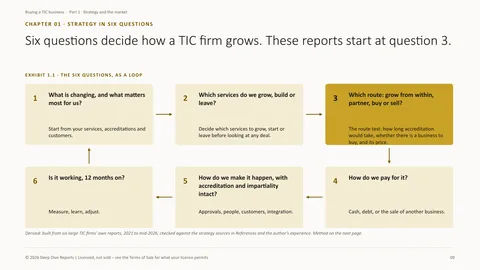
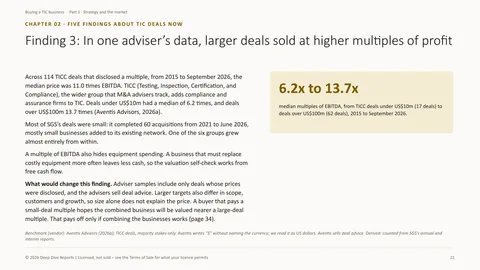
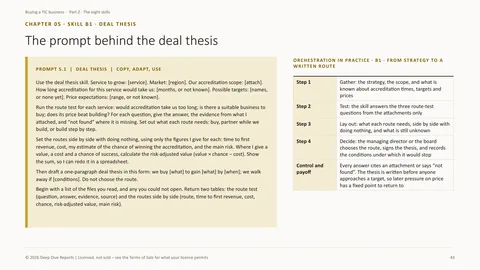
Contents
All 77 pages, listed.
- Summary3
- Words used in this report6
- Part 1 · Strategy and the market8
- 01Strategy in six questions9
- 02Five findings about TIC deals now16
- Finding 1: Large groups buy in growth areas and reshape their portfolios17
- Finding 2: Few deal announcements name accreditations: 10 of 75 did19
- Finding 3: In one adviser's data, larger deals sold at higher multiples of profit21
- Finding 4: Private equity is active in the largest deals23
- Finding 5: The main deal risks sit in accreditation, people, customers and the integrity of results25
- 03Why buy, and what makes a TIC business worth buying31
- 04How to use the skills safely36
- Part 2 · The eight skills41
- 05Skill B1 · Deal thesis42
- 06Skill B2 · Target pipeline and fit44
- 07Skill M1 · Valuation self-check47
- 08Skill M2 · Approvals map50
- 09Skill B3 · Due-diligence red flags52
- 10Skill B4 · Customer overlap57
- 11Skill B5 · People and culture fit59
- 12Skill B6 · First 100 days and 12-month review61
- Part 3 · The other side, and reference63
- 13What the seller is checking64
- AAppendix A · TIC due-diligence checklist66
- References69
- How this report was made75
Read enough?
The rest is the evidence, the eight skills and the worked example.
Licences start at US$199 for a single named reader. Reports are delivered instantly: the report and its skills pack.
Every licence includes the eight skills, at no extra cost: files you add to an AI assistant so each step runs without pasting its prompt. What the skills are, and where they run.