AI in TIC Playbook · Volume 2

AI for Key Account Management

Twelve AI workflows – with the complete prompt toolkit – to keep an account plan true, forecast the installed base, and stay inside what your accreditation permits.
By Allen Chen · Published 18 September 2026 · 58 pages · PDF · Version 1.0 · Research cut-off 17 September 2026 · Sources last verified 17 September 2026

Instant download, under a named-user licence.

Cover of AI in TIC Playbook Volume 2, AI for Key Account Management, by Allen Chen

The argument

In TIC the account is the business, and the account plan is rarely current.

A TIC firm's revenue is unusually predictable. Certificates expire on known dates, surveillance audits fall due on a cycle, standards get revised and the testing repeats. Inspections recur. Few industries know that much about next year's work this far ahead – and most firms still forecast it from a pipeline of opportunities, and reward it as new business.

The same is true of the account plan. The problem is not that an account plan misses facts that stay true for years. It is that those facts change at wildly different rates, and all of it gets one review cycle. Half the plan is reviewed too often, and half is behind. AI changes the cost of keeping a plan true, not the cost of writing it.

Every figure carries its source, and a label saying how much weight it will bear. How the research is done sets out the checks behind them.

A plan in which nothing looks old is a plan you cannot weigh.

Every entry needs its source and its date, or the newest fact and the oldest guess read the same.

Look inside

Pages from the report.

Shown at reduced size. The free preview gives you the contents page, the executive summary and sample pages at full size.
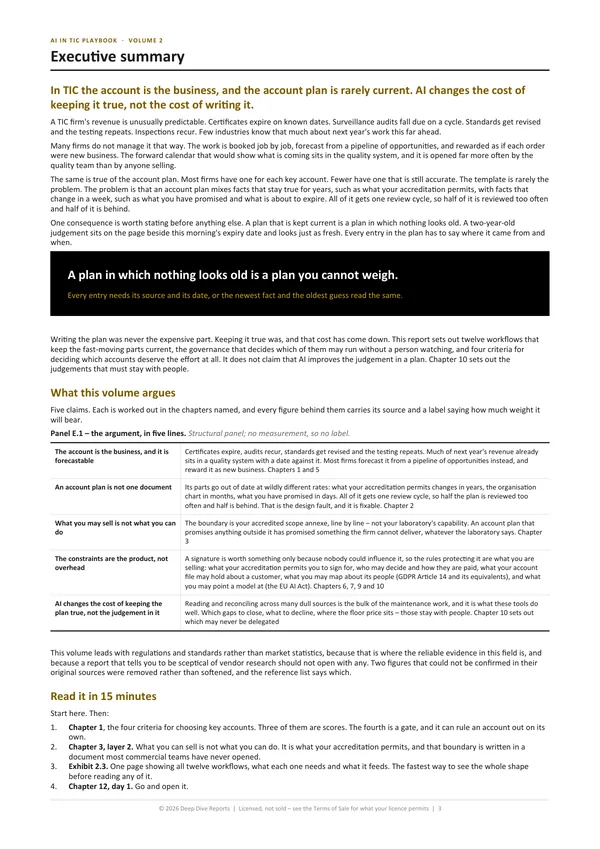
Executive summary page, showing the argument in five lines with the chapters behind each claim
Executive summary – the argument in five lines, each with its chapters
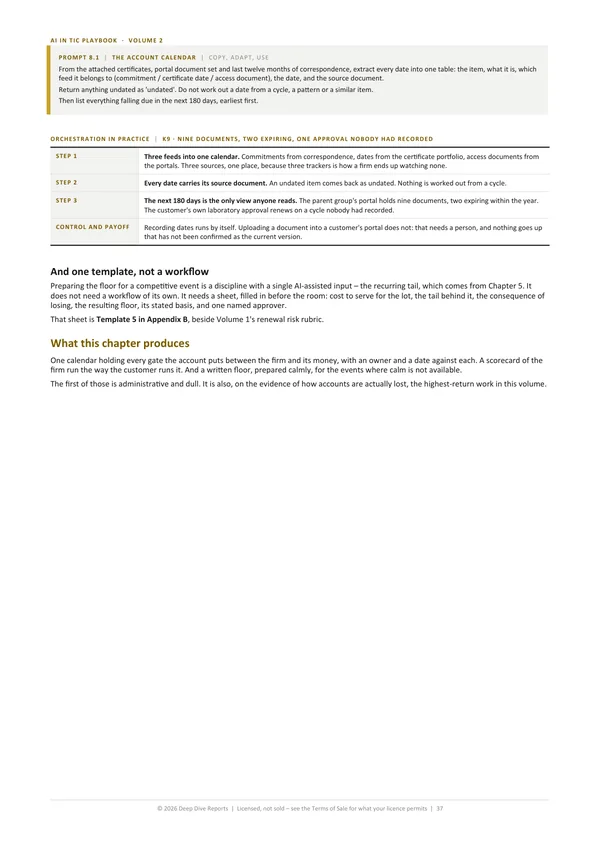
A page from Chapter 8, showing a workflow prompt and its orchestration steps
Chapter 8 – a workflow's prompt, and the steps around it
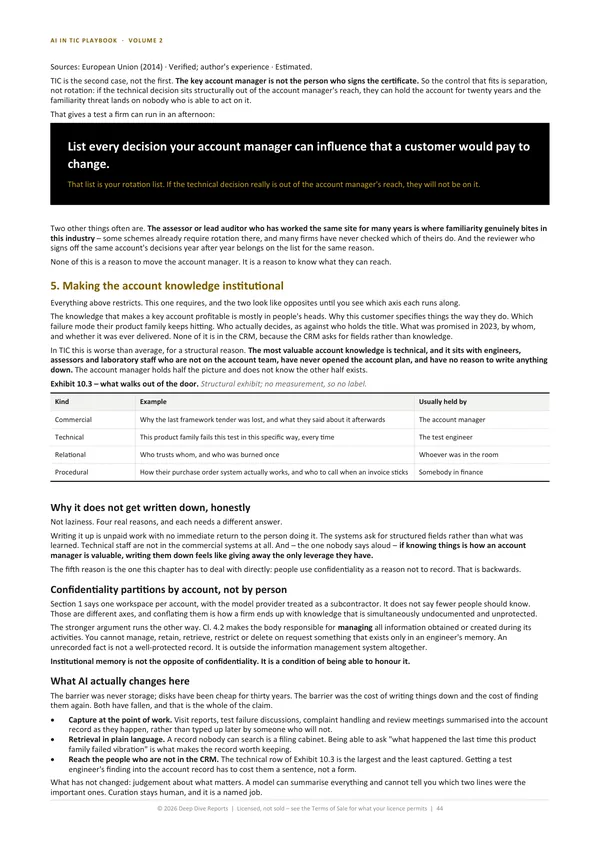
A page from Chapter 10, showing an exhibit on what a firm knows about an account and who holds it
Chapter 10 – governance, and what the firm actually knows

Contents

What is in the 58 pages.

  • Executive summary – in TIC the account is the business, and the account plan is rarely current3
  • 01Why key accounts are different in TIC5
  • 02The plan that goes stale9
  • 03The four-layer fit assessment12
  • 04Their strategy, their chain, and where you fit19
  • 05The account revenue plan24
  • 06Credit terms and receivables27
  • 07Competitive intelligence you can defend30
  • 08How the account buys, and what it demands of you34
  • 09Value the customer will agree with38
  • 10Governance for account teams42
  • 11The 90-day build, and what to measure47
  • 12Your first seven days50
  • AAppendix A – glossary52
  • BAppendix B – the toolkit: five templates54
  • Full reference list56
  • How this report was made58

Panel E.1, reproduced from the report

The argument, in five lines.

Forecastable

The account is the business, and much of next year's revenue already sits in a quality system with a date against it. Chapters 1 and 5

Not one document

An account plan's parts go out of date at wildly different rates, and all of it gets one review cycle. That is the design fault, and it is fixable. Chapter 2

Scope, not capability

What you may sell is your accredited scope annexe, line by line – not what your laboratory can do. Chapter 3

Constraints are the product

A signature is worth something only because nobody could influence it, so the rules protecting it are what you are selling. Chapters 6, 7, 9 and 10

Cost, not judgement

AI changes the cost of keeping the plan true, not the judgement in it. Chapter 10 sets out what must stay with people.

Included

Every licence includes the twelve workflows as skills.

A skill is a file you add to an AI assistant, so a workflow runs without pasting a prompt into the chat.

Each skill carries one workflow, its prompt and the rules around it, word for word from the report. They come at no extra cost, and the report is complete without them, because every prompt in a skill is printed in it.

Built to the open Agent Skills format. Claude, ChatGPT, Microsoft 365 Copilot and Gemini each document how to load a skill in this format, on some plans and in some countries; the start-here guide in the download links each maker's instructions and states what each one needs. Installed and run in Claude on 18 September 2026. We do not claim what we have not tested.

  • K1 Fit and permission – two verdicts for each customer need: can we do it, and may we under our scope
  • K2 Buying group – the customer's roles, and which of your people reaches each one
  • K3 Gap register – a draft gap register, with the decision column left empty
  • K4 Strategy reader – dated signals from the public record, ranked by what each one cost them
  • K5 Revenue base – a banded revenue forecast for the next twelve months
  • K6 Decline risk – signals against your contracted and cyclical lines, each with source and date
  • K7 Credit and exposure – days beyond terms by month, and exposure across the account's entities
  • K8 Competitive brief – what changed in overlapping scope since the last run, scope and dates only
  • K9 Account calendar – every date in one table, then what falls due in the next 180 days
  • K10 Value case – a value case skeleton, with the customer's figures left blank
  • K11 Plan refresher – the entries newer evidence contradicts, the undated ones and the overdue ones
  • K12 Knowledge capture – candidate entries for the account record, each marked observed or inferred

Licences

Choose the licence that matches how the report will be used.

Every licence is for the same 58-page report. What differs is how many people may read it.

Single reader

US$199

One named individual

  • Licensed to one named person
  • Read it, print it, keep one copy
  • Not to be shared with anyone, including colleagues
Buy single reader

Team

US$399

Up to 10 named readers at one site

  • Share the file with your named colleagues
  • Quote short extracts in internal documents, with credit
  • Store it on a drive your team, and only your team, can reach

Buying for an organisation? You can enter its VAT or tax number at checkout.

Buy team licence

Enterprise

US$999

Unlimited readers in one organisation

  • Everyone in the organisation, worldwide, may read it
  • Quote short extracts in internal documents, with credit
  • Store it on your intranet, behind your own login

Buying for an organisation? You can enter its VAT or tax number at checkout.

Buy enterprise licence

What no licence allows

Reselling, sublicensing or redistributing the report. Publishing it, posting it online, or placing it in a shared drive open to people outside your organisation. Reproducing substantial parts of it in anything published or sold. Removing our name, citations or copyright notices. Using it to train an AI or machine learning model.

Read the preview first

The free preview gives you the full contents page, the executive summary and sample pages. Reports are delivered instantly and cannot be returned, so we would rather you decided with the evidence in front of you.

Video overview · 8 min

The argument of the report, in eight minutes.

Slides generated with Claude. The script was generated by NotebookLM from the report, the narration is a synthetic voice, and the voice was altered in editing. Allen Chen directed the script and holds editorial responsibility. The report is the authority.