Free preview · AI in TIC Playbook · Volume 2
AI for Key Account Management
This is the report's complete executive summary, its full contents, and pages from inside it. Nothing is held back behind a form, and there is no email to give. Read it, then decide.
Executive summary
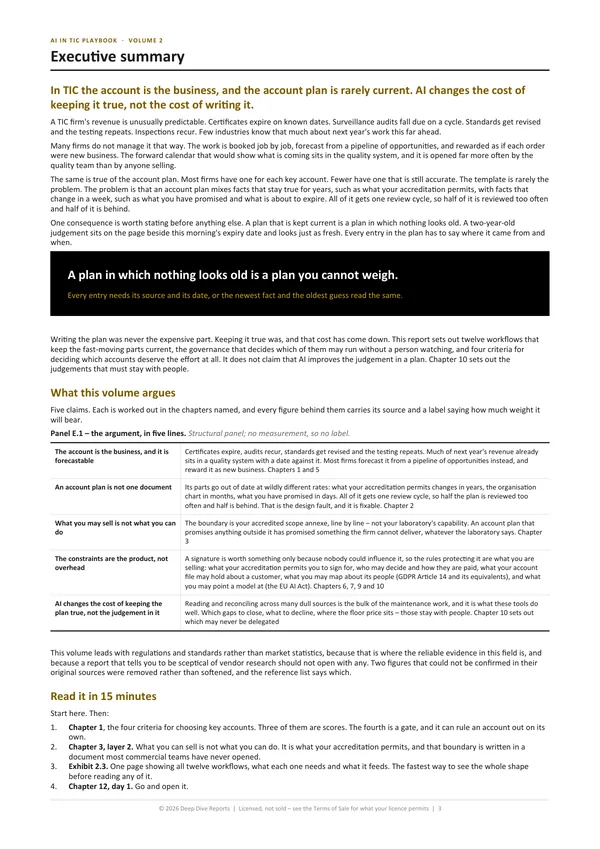
In TIC the account is the business, and the account plan is rarely current. AI changes the cost of keeping it true, not the cost of writing it.
A TIC firm's revenue is unusually predictable. Certificates expire on known dates, surveillance audits fall due on a cycle, standards get revised and the testing repeats. Inspections recur. Few industries know that much about next year's work this far ahead.
Many firms do not manage it that way. The work is booked job by job, forecast from a pipeline of opportunities, and rewarded as if each order were new business. The forward calendar that would show what is coming sits in the quality system, and it is opened far more often by the quality team than by anyone selling.
The same is true of the account plan. The problem is not that a plan misses facts that stay true for years. It is that its parts change at wildly different rates, and all of it gets one review cycle: half the plan is reviewed too often, and half is behind. A two-year-old judgement sits on the page beside this morning's expiry date and looks just as fresh.
A plan in which nothing looks old is a plan you cannot weigh.
Every entry needs its source and its date, or the newest fact and the oldest guess read the same.
Panel E.1, reproduced from the report
What this volume argues, in five lines.
Each claim is worked out in the chapters named, and every figure behind it carries its source and a label saying how much weight it will bear.
The account is forecastable
Certificates expire, audits recur, standards get revised and the testing repeats. Much of next year's revenue already sits in a quality system with a date against it. Chapters 1 and 5
An account plan is not one document
Its parts go out of date at wildly different rates, and all of it gets one review cycle. That is the design fault, and it is fixable. Chapter 2
What you may sell is not what you can do
The boundary is your accredited scope annexe, line by line, not your laboratory's capability. Chapter 3
The constraints are the product
A signature is worth something only because nobody could influence it, so the rules protecting it are what you are selling. Chapters 6, 7, 9 and 10
AI changes the cost, not the judgement
Reading and reconciling across many sources is the bulk of the maintenance work, and it is what those tools do well. Chapter 10 sets out what may never be delegated.
How to read the evidence in this report
Every figure carries its source, and a label saying how much weight it will bear.
Where a figure appears in an exhibit or a statistics panel, it also carries one of four labels, so you can see at a glance what it is worth.
- Verified
- Confirmed in the official or primary source.
- Benchmark
- A named third party's published figure. Marked (vendor) where the publisher sells what it measured, because a company measuring its own product is not independent evidence and should not be read as such.
- Derived
- Calculated here, with the method shown.
- Estimated
- A judgement made here, where hard data does not exist.
Pages from inside
What it looks like.
Shown at reduced size, so the layout is visible without the body text being readable.
Contents
All 58 pages, listed.
- Executive summary – in TIC the account is the business, and the account plan is rarely current3
- 01Why key accounts are different in TIC5
- 02The plan that goes stale9
- 03The four-layer fit assessment12
- 04Their strategy, their chain, and where you fit19
- 05The account revenue plan24
- 06Credit terms and receivables27
- 07Competitive intelligence you can defend30
- 08How the account buys, and what it demands of you34
- 09Value the customer will agree with38
- 10Governance for account teams42
- 11The 90-day build, and what to measure47
- 12Your first seven days50
- AAppendix A – glossary52
- BAppendix B – the toolkit: five templates54
- Full reference list56
- How this report was made58
Read enough?
The rest is the twelve workflows, the prompts and the governance.
Licences start at US$199 for a single named reader. Reports are delivered instantly.
Every licence also includes the twelve workflows as AI skills, at no extra cost: files you add to an AI assistant so a workflow runs without pasting its prompt. What the skills are, and where they run.